


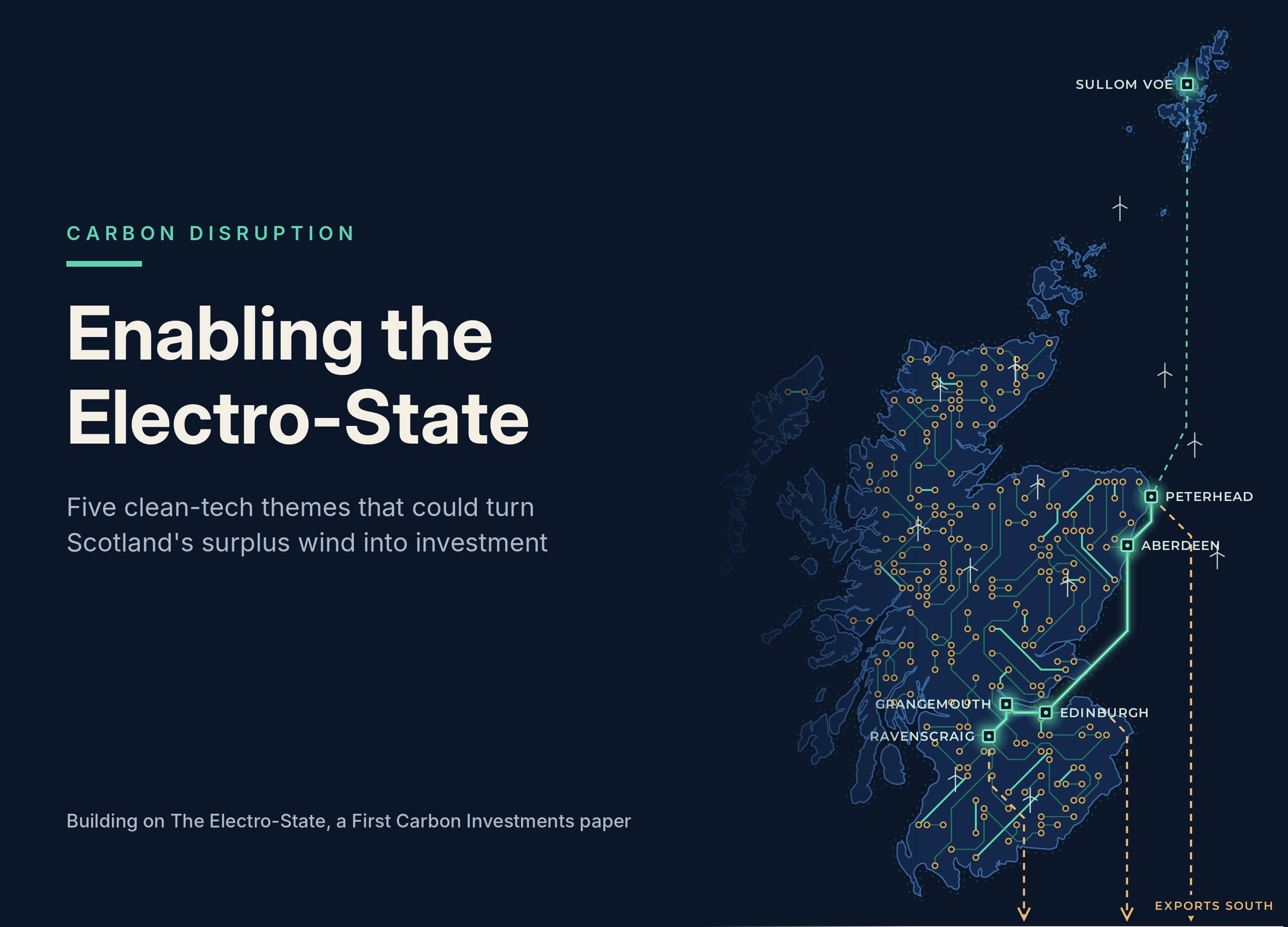
Last month First Carbon published The Electro-State, a short paper arguing that Scotland is becoming something new. We’re not proposing an electro-state in the Chinese sense that is a dominant manufacturing economy that runs more of itself on electricity. Instead we looked at an exporting one, which sells clean electricity the way petrostates sell oil or LNG, like say Oman. The numbers don’t have the same volumes as a gulf petrostate, but the output is continuous and currently a lot is wasted. In 2025 Scotland sent 20.8 TWh of net exports south, worth about £1.7bn, and paid roughly £350m to switch off more than 10 TWh of wind the grid could not carry. For every two units it sold, one was wasted.
The paper closes with six changes that would stop the waste and keep more of the value-add at home. The changes run from how electricity is priced to how energy is counted, and identifies which governing bodies can act. The changes do not need a new constitutional settlement and we’ve left that argument to others.
In this post we consider that policy only opens a door and business still has to walk through it. A cheaper local electron is worthless without a business that wants to buy it and use it. In my earlier post The Digital Refinery I considered how a public stake in data centres might help create an environment where more can be built. Scotland has power that is cheap at the margin and public capital ready to co-invest. To develop on this we need more clean tech and value added projects ready to receive investment.
So this piece asks the next question. If the six changes recommended in the Electro-State Report were made tomorrow, which kinds of clean technology would turn them into investment propositions? I’ve homed in on five themes, or investment thesis. There may be more so feel free to suggest them in the comment if you think I have missed something important . Each starts from a problem the paper documents, and each serves one or more of its recommendations.
1. Time-to-power
The problem. Scotland has 17.9 GW of installed renewable capacity and 84.8 GW in the planning pipeline. The four new subsea links to England add 8 GW, half by 2029 and half around 2034. That means transmission will keep chasing generation for a decade, and a business that wants Scottish power can wait years to connect. The connection problem is common internationally. The 24 hyperscale data centre proposals now in the planning system would need more than 6,000 MW between them which represents one and a half times Scotland’s peak demand. Holyrood paused decisions on them last month until national guidance is published.
Candidate clean tech. Some investors have a slightly different name for this problem: speed-to- power, but its the same problem statement. With data centres and industrial users now paying for certainty of supply above almost anything else, the busiest theses in energy venture capital are about getting existing grids to carry more and bringing power to a site rather than waiting for the grid to arrive. In Scotland that means anything that shortens the wait between deciding to use electricity and being plugged into a source.
These include:
Private-wire supply direct from generators to nearby demand.
Flexible and non-firm connection arrangements.
Grid-enhancing technologies that get more out of existing lines.
On-site and portable low-carbon power that lets a site start work before its permanent connection arrives.
Serves: Change 1, Price the local electron, and Change 2, Set data-centre rules that keep value in Scotland, which gives priority to constrained sites.
2. Follow-the-wind
The problem. In 2025, 39% of northern Scotland’s potential wind output never reached the grid. This creates a scenario where consumers pay twice, once to stop the turbines, and again to replace the power, mostly with gas. Value the lost output at £50/MWh and it is worth about £500m a year, on top of the £350m in payments to switch it off. You can watch the waste happen in close to real time on Windfall, an independent tracker built by Owen Thomas that maps how much of Scotland’s wind is being held back from the grid, every half hour.
Candidate clean technologies:
Demand that moves to the wind, rather than waiting for the wind to be moved to it.
E-fuel production technology and electrolysers sized to run on surplus hours.
Thermal storage that banks cheap power as heat, and the heat networks it can feed.
Long-duration storage.
Computing workloads that can flex.
The common feature is a load that switches on precisely when the grid would otherwise pay to switch generation off. There is evidence that investors are backing exactly this. In July Antora raised $550m, with BlackRock and Breakthrough Energy Ventures among its backers, for thermal batteries that charge on cheap surplus renewables and discharge when prices peak.
Serves: Change 1, which makes using surplus power cheaper than curtailing it, and Change 2, which makes flexible operation and heat reuse conditions of data-centre consent.
3. Power-to-X
The problem. Exported raw, Scottish electricity is sold at the wholesale price and the value-added product or service is created somewhere else. That is repeating the petrostate mistake in a new form where you sell the commodity then import the value. Norway and Britain drew oil from the same basin at the same prices but Norway collected about $1.2 trillion and invested it while Britain collected $470bn and built no fund at all.
Candidate clean tech. The refining industries of the electro-state:
Data centres come first, because they turn electricity into a service that travels without a transmission line, and because that is where the capital is, low-carbon data centres took about a third of all climate tech venture funding in the first half of this year.
Electrified industrial heat follows close behind. Whisky alone uses about 3.4 TWh of energy a year, most of it to raise steam, against more than 10 TWh of wind switched off in 2025. At Annandale Distillery near Dumfries, an Exergy3 thermal store now turns electricity into that steam, charging when wind power would otherwise be curtailed. Behind whisky sit the maltings that supply it, the wider food and drink industry, paper mills and the chemicals cluster at Grangemouth, all of which need large amounts of steam and low-temperature heat.
Then come green hydrogen, e-methanol and SAF, of which Veri Energy’s plans at Sullom Voe, supplying Grangemouth, are an early example. New mandates for e-fuels are creating demand in sectors from airlines, road transport and maritime.
Here investors have cooled sharply, with venture funding for low-carbon fuels down by more than half as buyers wait on policy reviews. They require government and inter-government actions to drive adoption. UK, EU ETS, FuelEU and IMO action in maritime could all be game changers. Some are on the books, some are being drafted.
Serves: Change 3, Own a share of the refinery, and Change 4, Invest the windfall, which would ring-fence £659m of unspent ScotWind fees as a transition fund. These are the assets that public and community equity would actually own. There are some more thoughts on using UK ETS revenues in my earlier newsletter on The Carbon Gap
4. Proven-at-source
The problem. The EU’s carbon border charge came into force in January, and Britain’s begins in January 2027. The UK scheme counts the emissions from the electricity used to make goods rather than just from the manufacturing process. A plant powered by Scottish wind carries a far smaller carbon bill than one on gas or coal power, but only if it can prove it though a chain-of-custody. Clean power is becoming a trade advantage which can be hardened if provenance is proven at the border.
Candidate clean tech. The plumbing of provenance, and above all the tools that let an exporter prove the embedded emissions of what it ships.
Measurement, reporting and verification systems and standards that a customs authority or a lender will accept and trust. This is a field where border-charge compliance software is already attracting seed funding.
Time-matched certificates that tie consumption to specific generation. Book-and-claim systems do a neat job of digitising this process.
Attribute markets that let buyers pay for the environmental claims value of a product separately from the product itself have helped to finance investment in SAF production.
Investors have cooled on carbon markets as a category but the case here rests on trade compliance rather than voluntary offsetting. (A declaration: H2C, a First Carbon venture, works in this space.)
Serves: Change 5, Make projects investable, which calls for standard certificates alongside standard offtake, and Change 6, Count useful energy. The second is a statistical reform rather than a market one, but it rests on the same principle. What is measured properly tends to be valued properly.
5. Plug-and-scale
The problem. Of more than 2,000 low-emissions hydrogen projects announced worldwide, only about one in twenty-five has reached a final investment decision. The technology usually works, but projects stall when each one is bespoke, when advance orders don't materialise, or when the infrastructure to distribute the product hasn't been built. The capital is there for example SNIB committed a record £374m last year and drew £445m of co-investment alongside it. Too often it's projects that aren't built to scale and investment ready.
Candidate clean tech. This is more about how technology is deployed than the technology itself.
Where possible modular, standardised plant that can be replicated from site to site.
Contracts, data and commercial designs that carry over from the fifth project to the fiftieth and provide investor signals when there are needed
Companies built and priced as scalable commercial platforms, rather than as a series of one-off builds.
Serves: Change 5, whose standard offtake and co-investment terms are what make replication financeable, and Change 3, because a public stake is far easier to take in a repeatable platform than in a single plant.
Reading the map
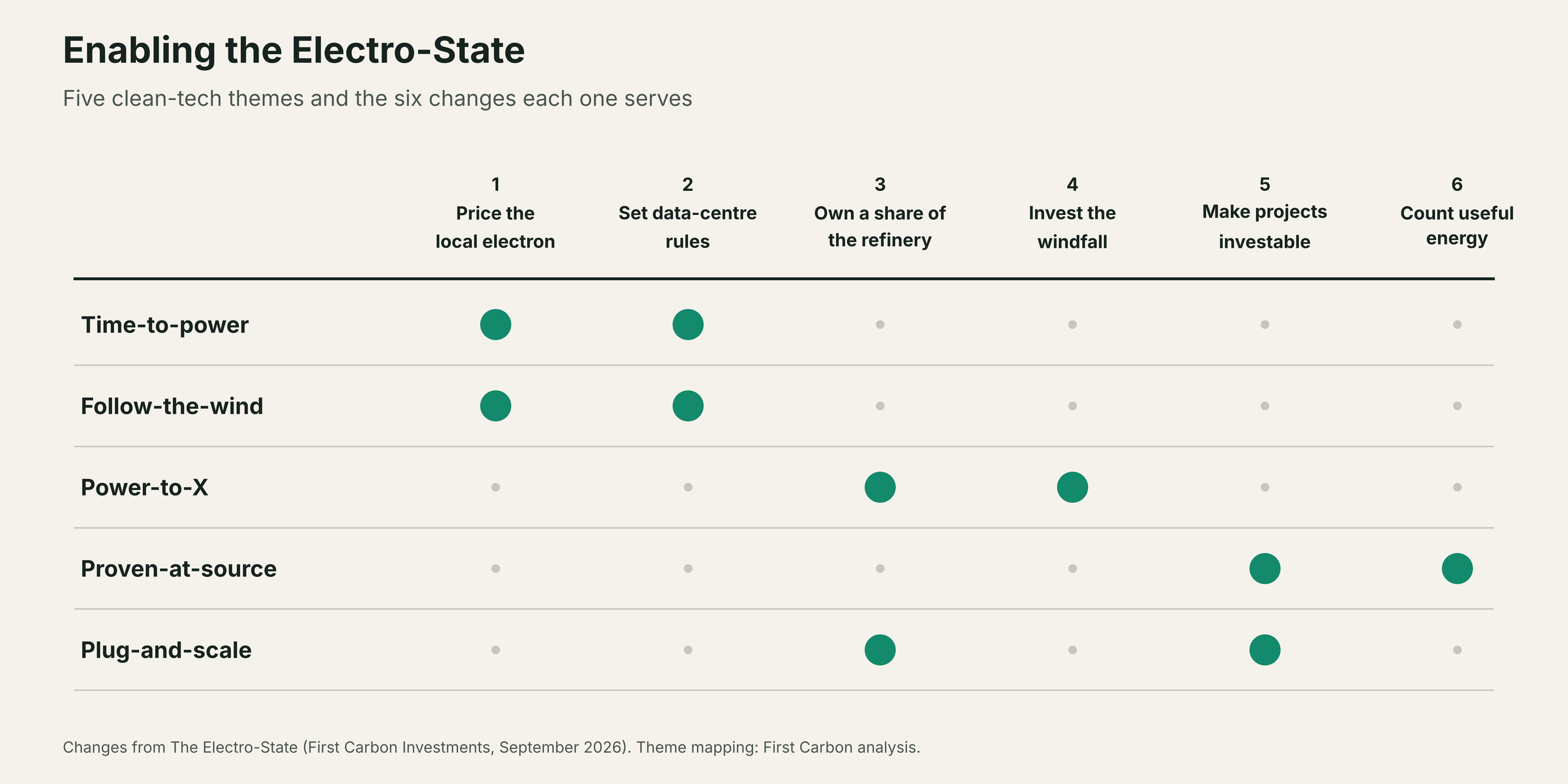
In the table above we’ve compared clean tech thesis side by side with the recommended changes to improve the outcomes of an exporting Electro-State. From this we concluded two things:
The first is that the most attractive opportunities sit where reforms overlap. A data centre on a constrained site, built to flex with the wind and sell its waste heat locally, would benefit from Changes 1, 2 and 3 at once. An e-fuel plant running on curtailed power, with certified provenance and a standard offtake contract, touches four. Investors looking for an edge could start at those intersections rather than with any single technology.
The second is more challenging in that none of the six changes has yet been made, and the paper lists the policy risks. These include the planning pause on hyperscale data centres, the reform of grid connections and transmission charges, the review of the aviation fuel mandate and development of ETS and border mechanisms. Anyone backing these themes today is pricing companies whose markets depend partly on decisions not yet taken.
I don’t believe that is a reason to wait as curtailment, connection queues and border carbon charges exist whatever Ofgem decides about local pricing. The technologies also scale into international markets with similar problems. The companies that solve those problems now will be the ones ready to receive capital as the rules change, which is precisely the gap the paper identifies. What is increasingly interesting is the case for low carbon power no longer rests on decarbonisation alone. Cheap home-grown electricity is a hedge against the next fossil price shock, which is increasingly how British cleantech investors frame their thesis.
I concede there is also a gap that 28.7% of Scottish households were in fuel poverty in 2024, and none of these five themes speaks to them directly. Heat pumps, home batteries and tariffs that pass cheap surplus power through to households belong in an electro-state that shares its windfall, but investors remain lukewarm on them. That may be the theme that needs public capital first.
Over the coming issues Carbon Disruption will take each theme in turn, starting with the one that is most pressing for anyone trying to build in Scotland today; time-to-power.
If you are building or investing in one of these five spaces, I would like to hear which problem you are solving and which of the six changes would move your project fastest. And if you have not yet read the paper, it is free to download here.
I publish regular articles on carbon finance and clean tech. Subscription is free and I’m always keen to hear your thoughts. Over the coming weeks we’ll dig deeper into enabling technologies. I hope you can join me for the ride.
Figures are from The Electro-State and the sources it cites. The £500m value of curtailed power uses First Carbon's assumption of £50/MWh.
Sources
First Carbon Investments, The Electro-State: Scotland and the successor to the petrostate, September 2026, and the sources it cites, including Scottish Government energy statistics, Ember, Modo Energy and the Scottish National Investment Bank
Windfall: Scottish Energy Tracker, live curtailment data
CTVC, H1’26 climate tech funding up 55% to $26bn, thanks to data centers
Global Venturing, Energy investment in 2026: speed first, cost second, clean third
Sightline Climate, Your 2026 prediction bets
Speed & Scale, Climate capital’s rebound
Energy Connects, Antora raises $550m amid data center boom
Trending Topics, Artem CBAM software raises seed funding
International Energy Agency, Hydrogen Production and Infrastructure Projects Database, June 2026 edition
Insightful article Peter. One of the key elements we were lobbying for was to manufacture technology such as electrolysers and energy storage technology. We came up against the usual suspect naysayers and vested interest. All best, Jim