

The decarbonisation of maritime transport is an operational imperative shaped by regulatory deadlines, tightening emissions limits, and market expectations for greener supply chains. Heavy fuel oil, the workhorse of ocean shipping for decades, now faces a phased decline as operators seek compliant and cost‑effective alternatives. In this post, I summarise four leading contenders, methanol, LNG, ammonia and green hydrogen. I look through the lens of lifecycle emissions, energy density, readiness for adoption, and their potential to reduce compliance costs under FuelEU Maritime, the EU ETS and the IMO’s forthcoming global framework. Compliance costs are escalating in scale and scope, and with spot markets for low carbon fuels some way off, the industry need to place orders for next generation fuels.
Analysing the Options
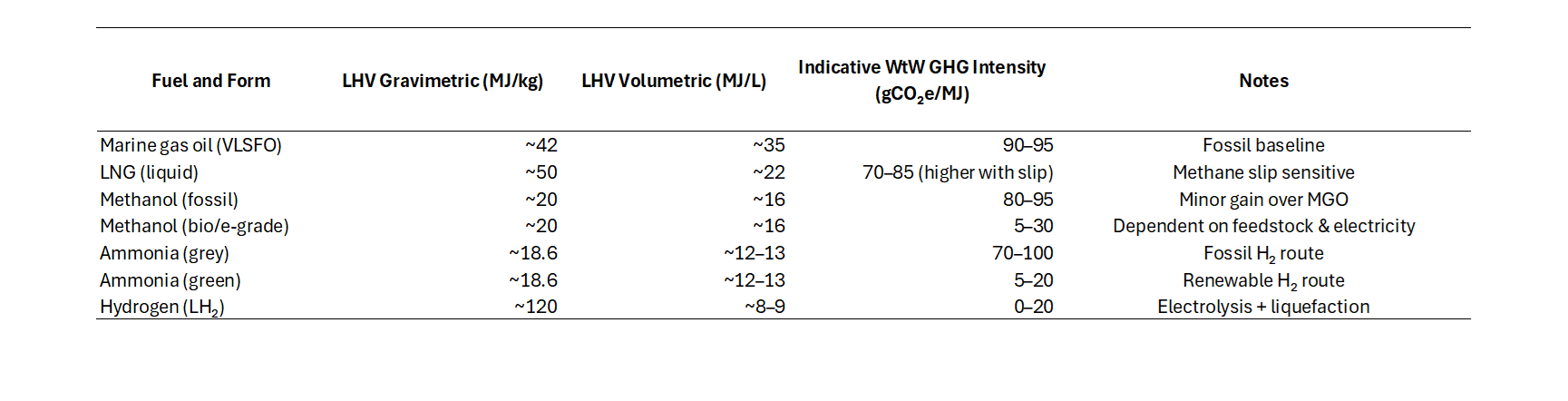
Methanol Methanol is attractive for its liquid state at ambient conditions and ease of storage. Fossil methanol offers marginal gains over marine gas oil, but bio methanol and e‑methanol from captured CO₂ and green hydrogen can achieve very high lifecycle reductions when powered by renewable electricity and sustainably sourced CO₂. Maersk’s methanol‑fuelled container ships, entering service from 2024, exemplify large‑scale fleet adoption. Bunkering is emerging in Northern Europe and China, though green supply remains constrained.
LNG LNG reduces local air pollutants significantly; however, methane slip and upstream leakage can erode GHG benefits. Over 150 LNG vessels operate today, supported by more than 20 global bunkering hubs. Without near‑total methane control across the value chain, LNG cannot meet mid‑century GHG reduction targets.
Ammonia Ammonia contains no carbon and produces no CO₂ at point of use. Lifecycle performance depends entirely on the hydrogen source. Green ammonia made via renewable hydrogen and nitrogen fixation can achieve deep reductions. MAN Energy Solutions targets commercial ammonia engines in 2025, with Wärtsilä following in 2026. Safety management is critical; global ports including Singapore, Rotterdam and Fujairah are running pilots. Existing fertiliser storage offers a head start for bunkering infrastructure.
Green Hydrogen Green hydrogen offers near‑zero lifecycle emissions when produced with renewables. Its low volumetric energy density necessitates liquefaction or high‑pressure storage, making it more suited to short‑sea shipping or as a precursor to ammonia or methanol for long‑haul routes.
Well‑to‑Wake: Why it Matters
Well-to-wake (WtW) analysis captures a fuel’s total lifecycle emissions—from production (“well”) to onboard combustion (“wake”). This approach aligns with FuelEU Maritime’s methodology, making it central to compliance and cost planning. Gravimetric energy density (MJ/kg) shows energy per unit of mass; higher values mean less fuel mass for the same range. Volumetric energy density (MJ/L) measures energy per unit of volume, influencing tank space requirements. WtW GHG intensity (gCO₂e/MJ) indicates climate impact per unit of energy delivered.
Compliance Economics: FuelEU Maritime, EU ETS, IMO
FuelEU Maritime From 2025, FuelEU will impose tightening limits on well‑to‑wake GHG intensity. RFNBOs such as green methanol and ammonia provide strong compliance value. LNG offers modest gains unless methane slip is tightly controlled.
EU ETS for Maritime From 2024, voyages to EU ports must surrender allowances for CO₂. Green ammonia and e‑methanol directly reduce surrender needs; LNG’s benefit is limited under ETS as methane is not priced.
IMO Trajectory The IMO’s net‑zero by 2050 ambition, with checkpoints in 2030 and 2040, will be underpinned by global well‑to‑wake standards. Early low‑carbon adopters will be positioned for regulatory and commercial advantage.
Fuel Switching Readiness
This readiness table reflects sample data but the landscape is evolving rapidly as new ships and infrastructure are commissioned. New vessel orders, fuel production projects, and bunkering infrastructure developments are announced frequently. As such, timelines and readiness levels may shift as technology matures, policies tighten, and market commitments accelerate. In terms of capital commitment the maritime industry is comparatively committed to global expenditure on new infrastructure.

Conclusion
The fuel transition in maritime transport will not be driven by a single solution, but by a portfolio approach that balances operational realities, regulatory demands and market incentives. Well‑to‑wake performance will increasingly define both compliance costs and competitive positioning. A spot market for these fuels is still some time away, as most production projects require firm off‑take commitments to reach financial close. This reality makes collaborative, forward‑looking procurement strategies essential. Industry players who commit early, leveraging models like H2C’s Pending Issuance approach, can secure supply, stabilise pricing, and accelerate investment in production capacity. Operators that invest early in low‑carbon fuels and supporting infrastructure will be better placed to secure charterer preference, minimise exposure to carbon pricing, and future‑proof fleets against tightening international standards. The window for strategic positioning is open now; the pace of adoption will be determined by how quickly the industry aligns technology, policy and finance to deliver scalable change.