

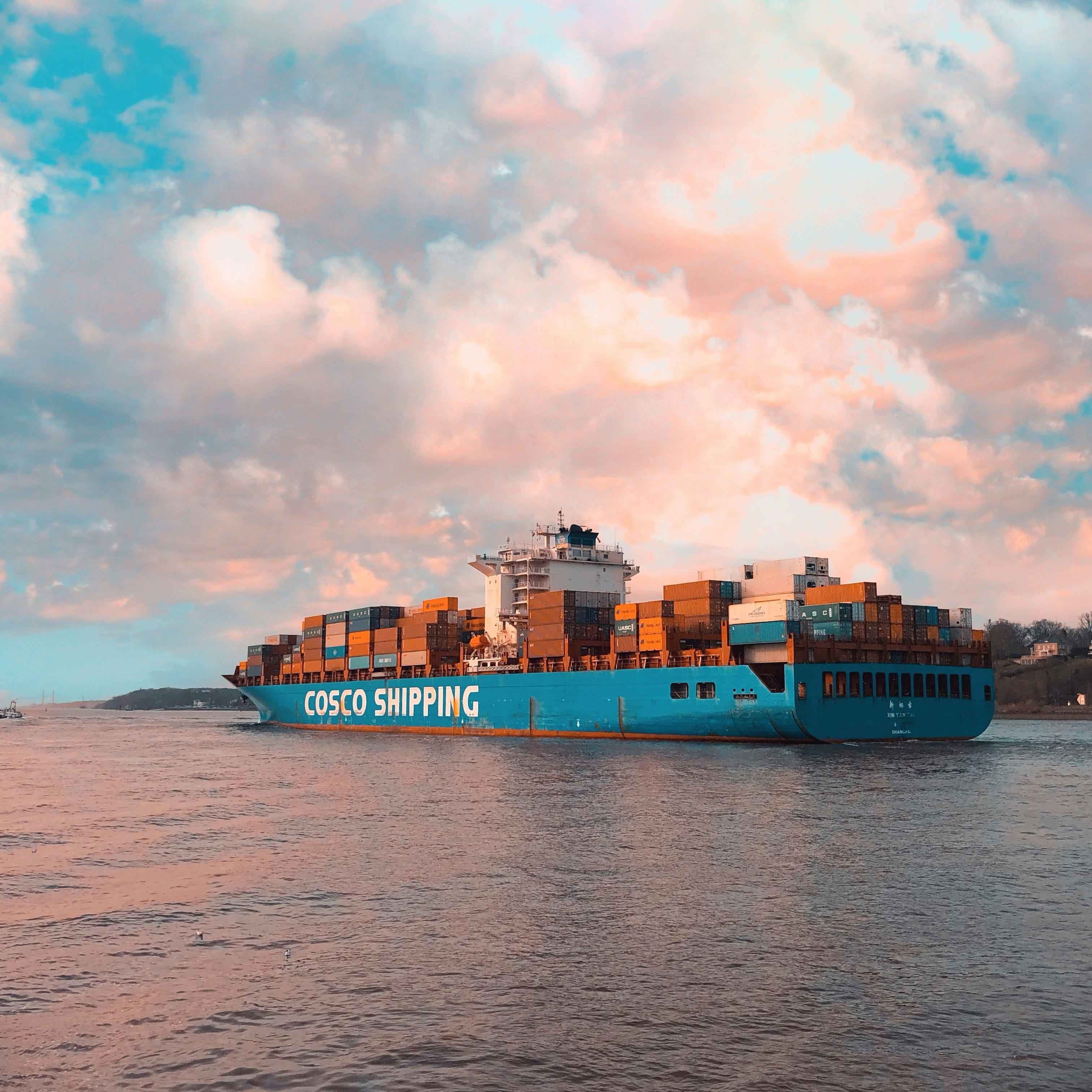
photo: Andreas Dittberner - Unsplash
90% of everything you own came by ship.
But shipping also emits 4% of global CO₂ and regulators are now forcing the industry to decarbonize with big penalties for those who keep burning dirty bunker fuel. Hot on the heels of the IMO's decision to implement global compliance regimes, we expect decarbonisation and fuel switching to be key topics at September's London International Shipping - here's why.
Imagine a bulk carrier transporting iron ore from Brazil to Rotterdam. Powered by heavy fuel oil (HFO), the vessel emits approximately 3,000 tonnes of CO₂ on a single round trip. Under the European Union’s FuelEU Maritime regulation, starting in 2025, this voyage alone could trigger compliance costs of over €150,000, merely for failing to meet greenhouse-gas intensity benchmarks. Add in potential charges from the EU Emissions Trading System (ETS), and the economic equation swiftly becomes unsustainable for traditional fuels.
Now consider an alternative: the same voyage using e-methanol or green ammonia derived from green hydrogen (gH2+). While the fuel itself may cost two or three times more upfront, the voyage avoids regulatory penalties, aligns with customer expectations around environmental, social and governance (ESG) criteria, and qualifies for Scope 1 and Scope 3 emissions reporting benefits, particularly when certified via Green Premium Certificates (GPCs).
Shipping, heavy industry and long-haul transport are under intensifying pressure to decarbonise. As regulatory frameworks like FuelEU Maritime and the EU ETS advance, the cost of emitting carbon or failing to meet emissions-intensity targets is escalating. This regulatory shift is catalysing an economic transition away from legacy fuels, such as HFO, and towards low-carbon alternatives including biofuels, e-fuels and gH2+ derivatives.
Yet these alternatives carry a price. Future market rates are anticipated to stabilise around $1,100 per tonne for biofuels, $1,600 for e-fuels, and potentially higher for gH2+, depending on region, production scale and certification standard. Bridging the economic gap between these prices and those of the legacy fuels they seek to replace is essential. Here is where Green Premium Certificates, and the initiative led by H2C.org, prove transformative.
Regulatory Incentives
FuelEU Maritime imposes progressively stringent greenhouse-gas intensity targets on shipping fuels. Non-compliance penalties can rise to €2,400 per tonne of very low sulphur fuel oil (VLSFO) equivalent energy. LNG, though cleaner, still contends with methane-slip risks and incipient ETS-related costs of up to €74 per tonne, owing to unburned methane emissions.
The EU ETS now encompasses maritime and industrial sectors, amplifying cost pressure. Carbon allowances have recently traded at €80 to €90 per tonne. As sectoral coverage expands, emitters relying on HFO or even LNG face mounting exposure.
The Transition Pathways
The transition unfolds along several distinct vectors:
HFO to biofuels. Biofuels provide drop-in compatibility and modest lifecycle-emissions reductions. However, they cost over $1,100 per tonne. Even after accounting for avoided regulatory costs, perhaps $50 to $100 per tonne, operators must still absorb a residual premium of $400 to $700 per tonne, contingent on region and fuel-market dynamics.
LNG to e-fuels. LNG offers a transitional benefit, but methane slip and regulatory tightening blunt its advantages. E-methane or e-methanol, when derived from green hydrogen, delivers near-zero lifecycle emissions but commands prices of up to $1,600 per tonne. After deducting regulatory savings, a premium of $600 to $1,000 per tonne often remains.
gH2+ fuels. Green ammonia, methanol and hydrogen-based carriers emit no carbon at the point of use. Prices typically range from $1,600 to $2,000 or more per tonne. While regulatory penalties are avoided entirely, a green premium exceeding $1,000 per tonne frequently persists, a daunting proposition for industries operating on narrow margins.
These residual premiums, which endure even after mitigation of compliance costs, require structured financing solutions if clean-fuel adoption is to proceed at scale. This is precisely where GPCs enter the picture.
The Role of Certificate Markets in Financing the Transition
Green Premium Certificates introduce a novel mechanism. By decoupling the environmental attributes, the rights to make emissions claims under Scope 1 and Scope 3, from the sale of physical molecules, GPCs enable downstream stakeholders across the supply chain to co-finance the green premium.
H2C’s GPC1 and GPC3 certificates confer exclusive, unitised claims of provenance for each certified tonne of low carbon fuel. This permits producers to market fuels at or near parity with legacy equivalents, while allowing beneficiaries, from steelmakers to automotive firms, to purchase GPCs in order to make regulatory or voluntary disclosures.
The Future Cost Curve and the Market Rationale
As compliance costs mount and fossil-fuel subsidies recede, the price differential between clean and legacy fuels is increasingly offset by avoided regulatory exposure. Presently, operators using VLSFO face $50 to $100 per tonne in compliance surcharges; non-compliance can cost significantly more. By 2030, some analysts forecast that regulatory costs alone may approach or even exceed the prices of low-carbon fuels, particularly when carbon border adjustments and ESG-related finance terms are taken into account.
This convergence renders the economic rationale for H2C’s market intervention compelling. GPCs facilitate the early-stage adoption of credible, green-certified fuels by spreading the cost burden among those who derive regulatory, reputational or commercial advantage from decarbonisation.
Aligning Market Signals with Climate Objectives
To achieve net-zero targets, supply chains must be reengineered from the bottom up. Fuel-switching is inevitable; it must also be economically sustainable. Regulators are tightening the screws on emissions-intensive operations. Markets must now underwrite the shift to cleaner energy.
GPCs, as envisioned by H2C, offer a workable, interoperable pathway to scale up green hydrogen derivatives and their use across industries. By financing the premium rather than ignoring it, and by doing so across borders and sectors, the initiative holds promise as a linchpin of the global transition.
Want to know more? - Meet us at London International Shipping Week [https://lisw.com/] For enquiries PM me or contact info@h2c.org.