


In Brief
Scotland pays to switch off wind while businesses that want its power wait years for a grid connection. What is scarce is not electricity but a connection date.
There are four ways to shorten the wait
get more out of existing lines,
connect before the grid is ready,
build your own supply,
bring in bridging power that leaves when the grid arrives.
Almost all the technology is mature, and much of it has already been done at scale elsewhere, China included. In Britain most of it is still deployed one site at a time. The investable companies are the ones that make the fifth connection faster than the first.
The Electro-State Series
The series starts with The Electro-State, First Carbon's paper on what Scotland does with its surplus wind, and continues with Enabling the Electro-State, which sets out five clean-technology themes. This is the first in a series of deeper dives into the five themes: Time-to-power (this issue), followed by Follow-the-wind, Power-to-X, Proven-at-source and Plug-and-scale. If you want to track the series and more subscribe for free here.
Scotland runs two queues that ought to cancel each other out. In the first, wind farms wait to be told to switch off when grid capacity can’t carry their power to consumers. Last year 39% of northern Scotland’s potential wind output never reached the grid, and consumers paid roughly £350m for the privilege of not using it. In the second, businesses that want to use that power have to wait to be connected. Across Great Britain the queue of demand projects asking for a grid connection tripled in seven months, from 41 GW in November 2024 to 125 GW in June 2025, against a national peak demand of about 45 GW.
The most telling number, though, comes from the gas industry. Britain’s gas networks fielded 113 connection enquiries from data centre developers in 2024 and 2025, three times as many in the second year as the first. Future Energy Networks, which represents them, says a new gas connection typically takes six to 24 months, against a wait of up to 15 years for the electricity grid. It is an interested party and some of those enquiries are speculative, but the logic is hard to fault. When the cleanest power in the country is being thrown away, and the quickest route to a working site is a gas turbine, the problem is not supply. It is a plumbing problem.
In our last issue, Enabling the Electro-State, we took the argument of our paper The Electro-State a step further and set out five kinds of clean technology that would turn Scotland’s surplus wind into investment. This is the first of five closer looks, and it starts with the theme that matters most to anyone trying to build here today.
How we Judge the Technologies
Each piece in this series rates the technologies it covers in the same three ways.
The first is Maturity: is this still in the lab, at pilot, in early deployment, or mature? The second is How it is deployed, for example as a series of bespoke projects, each designed from scratch, or as a repeatable platform built from standard parts. These are different questions.
The third is: Where in the world it is furthest ahead. Founders often describe their project as first of a kind when it is really first in Scotland, or first in Britain. The world is large, and China in particular is building at a scale and speed that makes many British “firsts” look like the third or fourth.
The ratings are our judgement, and readers who know a technology better are welcome to argue with them.
Time’s Money
Investors have a name for this problem: speed to power. For a data centre, an electrolyser or an electrified distillery, the price of a megawatt hour matters a great deal less than the date on which the first one arrives. Capital sitting in a half-built shell earns nothing, chips depreciate in their crates, and customers sign with whoever can switch on first.
Regulators have now put a price on that date, if only indirectly. Ofgem’s July consultation on cleaning up the demand queue proposes that a 100 MW data centre should post between £23.8m and £71.3m on accepting a connection offer, returned at energisation, simply to keep its place. The aim is to flush out speculators, of whom there are plenty: data centres account for about 73 GW of the demand queue across some 315 projects. But the side effect is clarifying. A place in the queue has become an asset with a price tag, and anything that shortens the wait is worth real money to the people in it.
Britain is not alone, and not the worst case. The Netherlands declared grid congestion across much of North Holland in 2021, and requests above 50 MVA in Amsterdam have been effectively on hold since 2023. Operators wanting more than 20 MW there are quoted dates of 2028 or later. Every country electrifying quickly is discovering that wires take longer to build than the things that plug into them.
Reforms and Their Limits
Britain is at least moving. The first round of reform dealt mainly with generation. NESO’s Gate 2 process re-sorted the connection queue so that projects ready to build, and needed for the 2030 clean power target, go first. It has brought forward about 7.8 GW of projects by an average of six years.
Demand is next, under a separate Ofgem programme called demand connections reform. It has three strands, which Ofgem calls Curate, Plan and Connect. Curate decides who may join the queue and stay in it, using deposits and milestones aimed squarely at speculative data centres; that consultation closed in September and a decision is due before the year end. Plan, led by government with NESO, will decide which strategically important projects get priority and where. Connect is about creating more ways to get connected, and is itself split in two. Accelerate would let developers build and own their own high-voltage assets, including under a new independent transmission owner licence. Operate would let large loads connect sooner in return for agreeing to be flexible. Ofgem has promised a consultation on both this autumn. The next application window opens in late 2026.
All of that helps, but none of it builds a line. Transmission will keep chasing generation in Scotland for most of a decade, whatever is decided in Ofgem’s offices. And in Scotland there is a separate pause. Holyrood voted last month that no planning decisions should be taken on hyperscale data centres until national guidance is published, which ministers say will happen before the end of the year. A data centre can clear every planning hurdle and still wait years for its electrons.
So the useful question is not when the grid will catch up. It is what a business can do in the meantime. There are four answers, and they lead to quite different kinds of company.
Route one: Get more out of the wires already there
Power lines are rated on cautious assumptions about the weather. On a cold, windy day a line can safely carry a good deal more than its static rating, and in northern Scotland cold, windy days are when the wind farms are being switched off. Dynamic line rating uses sensors to measure the real headroom. SSEN Transmission has fitted it to more than 300 km of lines north of Beauly, exactly where constraint is worst. National Grid is extending it to over 900 km in England and Wales and expects an average capacity gain of about 8%. Wood Mackenzie puts the range for grid-enhancing technologies in general at 5% to 50% more capacity, delivered in weeks to eighteen months rather than a decade.
The technology is mature, and it is worth noticing whose it is. The three firms on National Grid’s contract are American, Belgian and Norwegian. The British opportunity lies in deployment and integration, not invention. The catch for investors is the customer. Onshore Britain has just three transmission owners: National Grid in England and Wales, SP Energy Networks in central and southern Scotland, and SSEN Transmission in the north. All three spend under price controls set by Ofgem, currently the RIIO-T3 settlement that began in April, and they buy at regulated speed. Good businesses can be built here, but they look like specialist industrial suppliers, not platforms.
Route two: Connect before the grid is ready
A non-firm connection lets a project plug in now on the understanding that it will be curtailed when the network is stressed. On the generation side this is already routine. SSEN’s distribution business says its Technical Limits programme has unlocked 7.1 GW of capacity by letting projects connect ahead of transmission reinforcement. Research on flexible connections suggests they can cut connection costs sharply and roughly halve lead times.
For large demand it is a harder bargain, and still at pilot stage in Britain. Respondents told Ofgem that such connections should stay voluntary, with a clear path to a firm one later. A data centre selling guaranteed uptime cannot simply stop when the grid asks. Some loads can, and that is the bridge to our next theme, follow-the-wind: electrolysers, thermal stores and flexible computing that are happy to run when power is plentiful.
But the real gap here is not the hardware that switches a load off. It is knowing how often that will happen. A lender can price a connection that is curtailed for a predictable number of hours a year. It cannot price one that might be curtailed for an unknown amount. American evidence suggests the number can be small. A study sponsored by Google, modelling six hypothetical 500 MW data centres on real transmission data, found grid power available in more than 99% of hours, with backup needed for only 40 to 70 hours a year, in exchange for connecting three to five years sooner.
The companies worth backing will be the ones that turn curtailment risk into a number a bank will accept: forecasting, controls and the contractual wrapper that sits between a non-firm offer and a financeable project. This is early, it is mostly software, and nobody yet owns it. The candidates so far are mostly American. GridCARE, working with Portland General Electric in Oregon, is using flexibility modelling to connect more than 80 MW of data centre load this year that would otherwise have waited. Camus Energy, a grid software company, and encoord, a transmission modelling firm, wrote the Google study with Princeton. In Britain, grid consultancies such as Novogrid are pitching power-flow forecasts of curtailment to developers and offtakers. The obvious incumbents are the forecasters whose numbers lenders already accept, such as Aurora Energy Research and LCP Delta, if they choose to move in.
Route three: Build your own supply
The bluntest answer is to bring the power to the site permanently. In the United States that has mostly meant gas. Developers are building behind-the-meter turbines because the grid cannot keep up, and Wood Mackenzie reckons such grid-bypassing projects can be delivered in two to four years, provided the equipment is already secured. If it is not, waits for turbines and transformers can run from three to six years, which rather spoils the point.
Scotland has an advantage the Americans would envy. The clean generation is already built, and much of it is constrained. A wind farm being paid to switch off is a supplier looking for a customer. That is the premise of the Lanarkshire AI Growth Zone, where DataVita plans 500 MW of data centre capacity fed by more than 1 GW of wind, solar and batteries over private wire. The Chapelcross proposal in Dumfries and Galloway, lodged last month, pitches private-wire links to around 1 GW of renewable generation within five kilometres of the site. Near Aberdeen, the developers of a proposed 600 MW campus at Blackdog are discussing a direct link to a floating offshore wind farm.
None of these is first of a kind. In Zhongwei, in China’s Ningxia region, China Datang began supplying a computing cluster directly from a 500 MW solar farm earlier this year, over four dedicated 110 kV lines that bypass the public grid. It is the first stage of a 2 GW scheme pairing solar with 1.5 GW of wind and storage, and Beijing wants renewables to supply about four-fifths of its AI data centres’ power by 2030. Scottish private-wire schemes should be judged against that benchmark, not against each other.
Private wire also has costs that deserve honesty. A user who leaves the grid leaves behind a share of the cost of running it, and someone else picks that up, which is why The Electro-State argued for pricing the local electron properly rather than letting the cheapest route win by default. And it needs firm backup for the hours the wind does not blow. If that backup is a gas engine, Scotland will have imported America’s answer along with its problem.
Route four: Bridging Power
The fourth answer is the one most often missed: power that arrives quickly and leaves when the grid connection finally comes. Bridging power is a rental business, not an infrastructure one. A site that is twelve or thirty months from its permanent connection can start commissioning on hired generation and containerised batteries, then hand the kit back.
This market already has a global leader, and it is Scottish. Glasgow-based Aggreko rents modular gas and diesel generators and battery units to data centres and industrial sites around the world, and has been lobbying for decentralised power in the UK on the grounds that grid delays put AI investment at risk. Its British pitch leans on generators running on HVO, a renewable diesel, which is cleaner than fossil diesel but still a combustion engine.
The cleaner version is batteries, and here the global view matters most. China makes most of the world’s battery cells and an increasing share of complete systems. Winning bids for four-hour storage systems in China averaged about ¥600 per kWh in August, according to TrendForce, though prices rose sharply that month. A British company building its own containers is competing with that. A British company that integrates them, sizes them, finances them as a rental fleet and moves them from site to site is not.
What makes this route attractive to investors is that it is the only one of the four that is a platform by nature. The same container serves the first site and the fiftieth. Every deployment teaches the operator something that makes the next one faster, and the asset earns again on each move. Its weakness is that it is a bridge, not a destination, and its value falls as the grid catches up. That is a reason to price it properly, not to ignore it, because on current form the grid will not catch up in Scotland for most of a decade.
The Map
Laid side by side, the time-to-power technologies look like this.
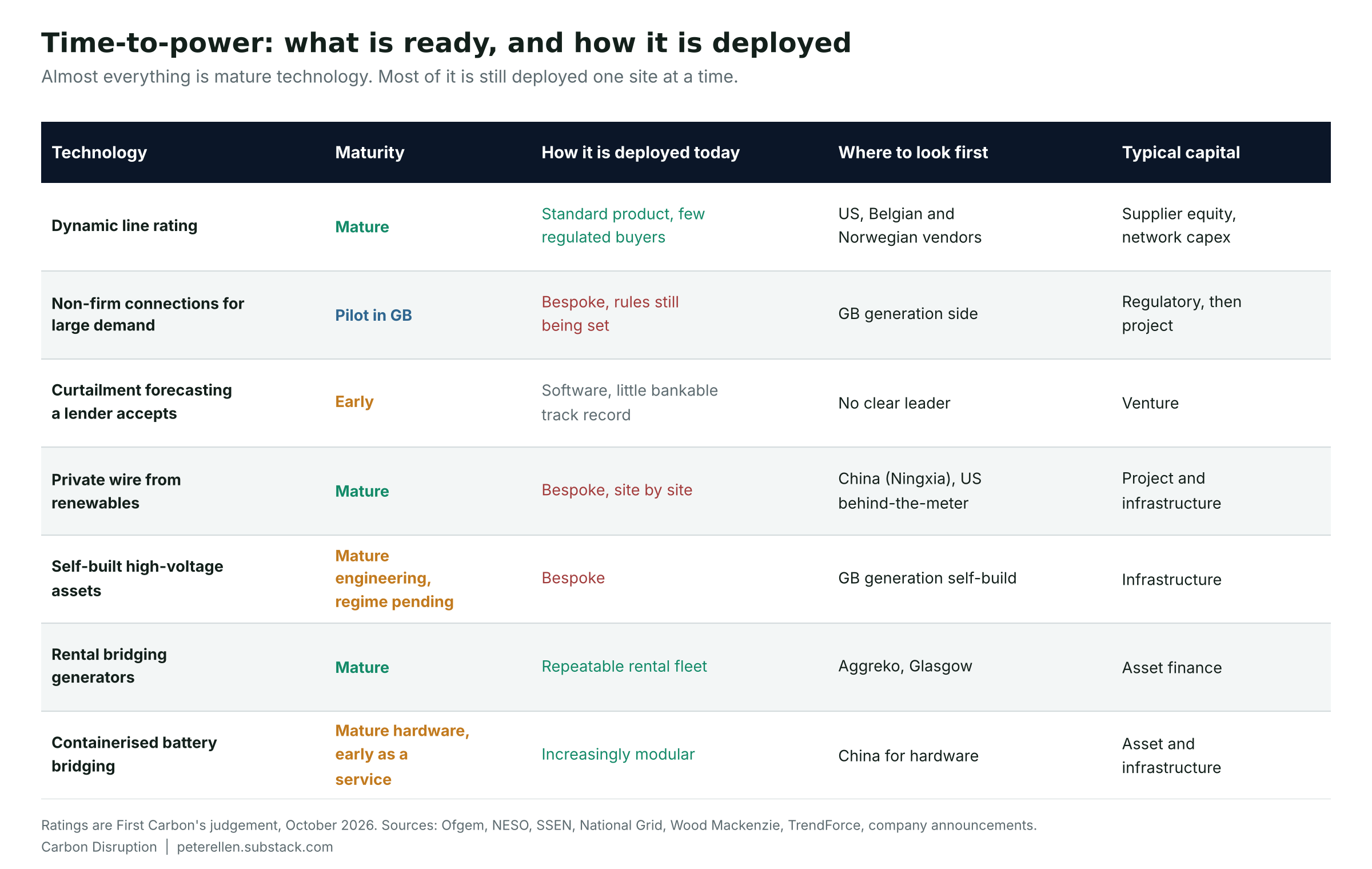
Two things stand out. Almost everything here is mature technology, so time-to-power is overwhelmingly a deployment problem rather than an invention problem. And most of it is still deployed bespoke. The gap between those two columns is where the money is.
Where the investable companies sit
Every private-wire scheme above is a project, with its own design, its own contracts and its own lawyers. As we argued in First of a Kind, capital that builds a single plant is priced like debt against an asset. The equity story lies in whatever makes the fifth site faster and cheaper than the first.
In time-to-power, that points to a fairly specific set of businesses. Standard private-wire designs and contracts that can be lifted from one site to the next. Bridging power, ideally batteries rather than combustion, run as a fleet. Curtailment forecasting that turns a non-firm offer into something bankable. And the engineering and ownership vehicles that will be needed if Ofgem does create an independent transmission owner licence, because self-built high-voltage assets will need someone competent to build, own and eventually transfer them.
The test for any company pitching in this space comes in two parts. First, who has already done this elsewhere, and what did they learn? A founder who cannot answer has not looked, and an investor will. Second, how many months did the company take off the last connection it delivered, and will the next one be quicker? If the answer is “it depends on the site”, the business is selling projects, however good the slides.
The Risks
Three deserve a mention. The rules are unsettled. Ofgem’s decisions on queue management, self-build and flexible demand are all due within months, and Scotland’s data centre guidance is still being written. A business built around today’s process could find it changed underneath it. Second, the supply chain is tight. The same transformers, switchgear and turbines are wanted by every grid operator and data centre developer in the world, and a speed-to-power business without secured equipment is not selling speed. Third, politics. Private wire and self-build both raise a fair question about who pays for the shared network, and the backlash against hyperscale data centres in Scotland shows how quickly community consent can become the binding constraint.
None of these is a reason to wait. The connection queue exists whatever Ofgem decides, and so does the curtailed wind. The businesses that can close the gap between the two, repeatably, will be worth backing long before the grid catches up.
Next time: follow-the-wind, and the loads that are happy to switch on when everyone else is being paid to switch off.
If you are building or investing in time-to-power, I would like to hear what is actually setting your connection date, which of the four routes you are betting on, and where in the world you think it is being done best. And if you have not yet read the paper behind this series, The Electro-State is free to download here.
Sources
Ofgem, Connect update: demand connections reform (June 2026)
Linklaters, Unlocking the queue: Ofgem’s proposed reforms for data centre connections
techUK, Ofgem details proposals to remove speculation from the demand connections queue
Browne Jacobson, Ofgem’s proposed data centre connection reforms
Slaughter and May, Market update on grid connections reform
Capacity, UK energy regulator promises power crackdown for data centres
Knight Frank, Connection reform update: a new pipeline announced
Transport & Energy, Data centre gas connections enquiries rise (Future Energy Networks figures)
Datacentres.com, Amsterdam data centre market and TenneT grid congestion (September 2026)
Euronews, Scotland halts new hyperscale AI data centre approvals
SSEN Transmission, Operating the biggest dynamic line rating network in the UK
Energy Institute, Dynamic line rating to expand capacity of existing UK power lines
IET, National Grid to expand tech roll out to boost power line capacity
Wood Mackenzie, Speed to power: the infrastructure solutions shaping the global data centre race
Utility Week, SSEN defers £44m of reinforcement work through flexibility
Latitude Media, A Google-backed blueprint for FERC’s data center fast lane
Solar Power Portal, Inaccurate curtailment forecasting could derail UK solar projects
Non-Firm Grid Connections: A Review of Access Types, Mechanisms, and Regulatory Frameworks
FutureScot, Lanarkshire chosen for AI Growth Zone status
AI Weekly / DCD, CX Tech files 1GW data centre plan at Chapelcross
DIGIT, Aberdeen tipped for 600MW AI campus powered by offshore wind
The Next Web, China wants its green power wired straight into the data centre
Data Centre Magazine, Aggreko calls for decentralised data centre power in the UK
North American Clean Energy, Aggreko bridges the grid power gap with modular microgrids
EnergyTrend / TrendForce, China energy storage system prices, August 2026
Some good news landed this morning. Sumitomo has opened the UK’s first HVDC subsea cable factory at Nigg, on the Cromarty Firth. That matters for time-to-power, because subsea HVDC cable has been one of the scarcest parts of the grid build, and until now it all came from abroad. It won’t clear the queue on its own. The offshore wind pipeline is far bigger than the links being planned, so the gap between power being ready and the wires being able to take it will be with us for years. That gap is where the opportunity sits.
Here are some companies working on faster time to power with behind the meter tech